

Could a remap reduce your fuel use, or simply change how your vehicle performs? ECU tuning for fuel economy can adjust how an engine responds, but advertised savings are not a promise for every car. It is reasonable to want clear answers before changing a calibration, especially if you are concerned about reliability or everyday performance.
The result depends on the vehicle’s condition, its existing calibration, the way it is driven and the kinds of trips it makes. A tune also will not fix an underlying mechanical fault, so diagnosis matters if fuel use has changed unexpectedly. This guide explains how calibration may influence fuel consumption, which factors shape the outcome and what a vehicle-specific assessment can tell you. Glasshouse and Landsborough Automotive Service and Repairs provides custom ECU tuning and remapping tailored to most vehicles, along with engine diagnosis and repair to help assess running issues. We look at what a considered remap may be able to do, where its limits lie and how to decide whether it suits your vehicle and driving goals.
Key Takeaways
- ECU tuning for fuel economy adjusts engine-control software, but fuel use also depends on vehicle condition, load and driving patterns.
- Potential efficiency gains depend on the vehicle and calibration. Smoother power delivery may help in some driving conditions, but results are not guaranteed.
- Compare fuel-saving claims by checking the vehicle tested, driving conditions, measurement method and limitations. Treat RaceChip’s figures as its own claims, not universal results.
- Before considering a diesel remap, identify your vehicle, assess its mechanical condition and clarify your driving goals.
- Glasshouse and Landsborough Automotive offers custom ECU tuning and remapping tailored to most vehicles, with engine diagnosis and repair to help assess running issues.
ECU tuning for fuel economy: what a remap changes
An ECU remap changes the software calibration that guides how a vehicle’s engine operates. ECU stands for Engine Control Unit, the computer that uses information from sensors to manage engine functions. A remap adjusts parts of that software for a particular vehicle and goal. Chip tuning, also known as ECU remapping, involves modifying software in a vehicle’s Engine Control Unit to alter engine performance and potentially affect fuel efficiency.
What does the engine control unit manage?
The ECU receives information from sensors around the engine and uses it to control how the engine responds as conditions change. Depending on the vehicle, this can include fuel delivery, ignition timing and, in a turbocharged engine, boost. The systems and available adjustments differ between models, so a remap is not one universal set of changes that can be applied in the same way to every car.
In plain terms, the ECU helps coordinate the engine’s response to inputs such as the accelerator and changing operating conditions. Remapping means changing selected instructions in the ECU’s software calibration. It does not automatically involve replacing parts or adding hardware.
Why can a calibration affect fuel use?
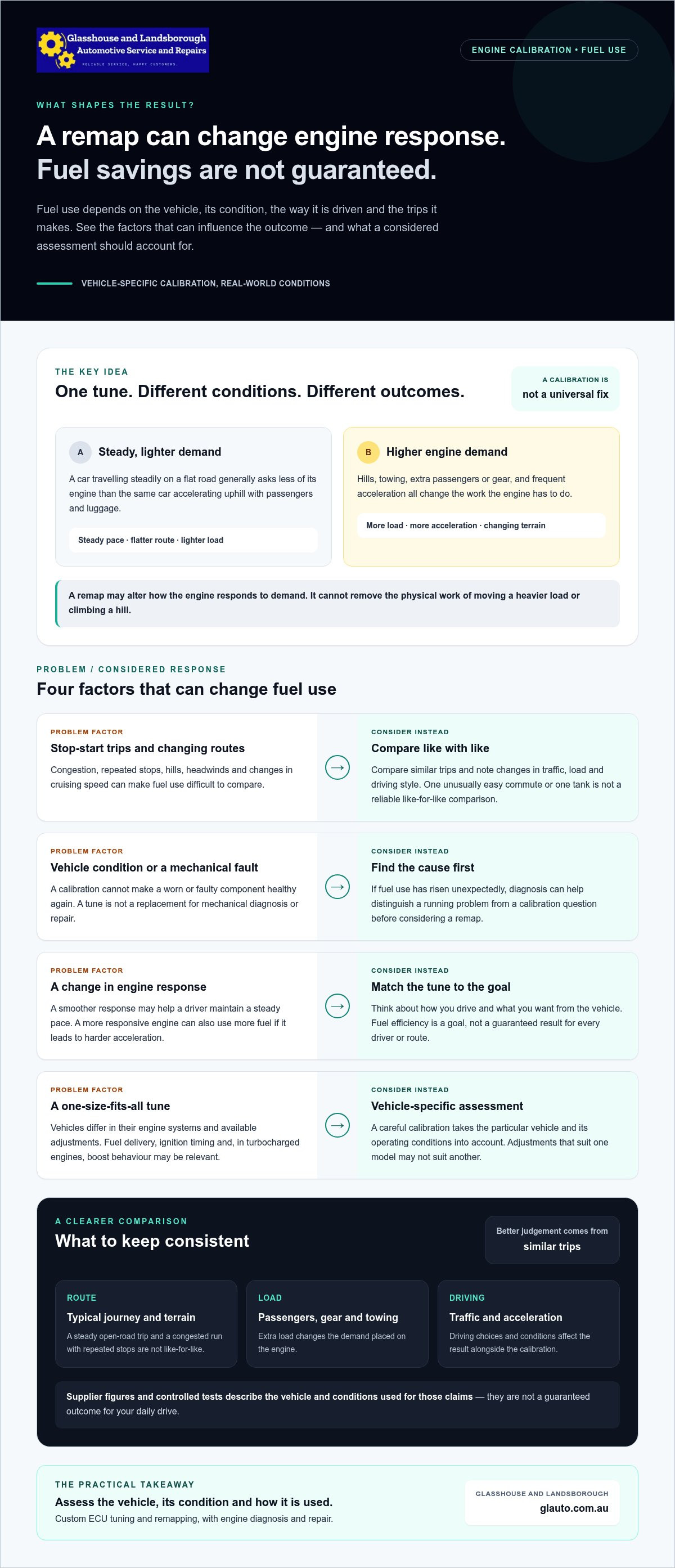
Fuel consumption shifts with the work an engine has to do. Carrying passengers or gear, towing, travelling up hills and accelerating often all place different demands on the engine. Stop-start trips and steady open-road driving also create different operating patterns. Vehicle condition matters too: a calibration cannot make a worn or faulty component healthy again.
A suitable calibration may change how the engine delivers power across some operating conditions. For example, a smoother response may help a driver maintain a steady pace, but the effect on fuel use depends on the vehicle, road and driving choices. If a tune encourages harder acceleration or more power is used, consumption may not fall. An efficiency target is a goal, not a guarantee for every driver.
Calibration outcomes depend on the vehicle and how it is used, so a fuel-saving claim cannot be applied to every car or driving routine. That is why ECU tuning for fuel economy should be considered alongside the vehicle’s condition and typical use, rather than as a stand-alone fix.
A remap is also different from mechanical diagnosis or repair. Software changes can adjust engine control, while repairs address physical faults such as damaged or worn components. If fuel use has risen unexpectedly, finding the cause is a sensible first step. A tailored assessment can help establish whether the vehicle’s condition, use and goals make a custom calibration worth considering.
How ECU tuning can influence fuel efficiency
A calibration can influence how an engine responds to changing demands, but it works within the controls and limits of that particular vehicle. The aim is not simply to reduce fuel delivery. Engine operation must remain appropriate for the vehicle’s design and conditions, and adjustments that suit one model may not suit another.
Fuel delivery, ignition and engine load
Depending on the engine and its control system, a tune may adjust fuel delivery, ignition timing or boost behaviour. These parameters affect how the engine produces power under different conditions, but the available adjustments vary by vehicle. A careful calibration works within vehicle-specific limits. It should not rely on an excessively lean mixture or sacrifice sound engine operation to chase a fuel-saving claim.
Engine load helps explain why fuel demand changes. A lightly loaded car travelling steadily on a flat road generally asks less of its engine than the same car accelerating uphill with passengers and luggage. Towing adds further demand. A calibration may alter how the engine responds to these conditions, but it cannot remove the physical work required to move a heavier load or climb a hill.
Fuel economy depends on engine operation and real-world use, including speed, acceleration, traffic, terrain and carried load. A smoother response may make it easier to drive steadily, particularly where frequent pedal adjustments are otherwise needed. But the driver still controls the accelerator, and a more responsive engine can use more fuel if that response leads to harder acceleration. The same tune can therefore produce different results in different hands and on different routes.
Why driving conditions shape the result
Changes in your usual journey can make a tune’s effect difficult to judge. A comparison between a clear, steady trip and a congested run with repeated stops is not like-for-like. Hills, headwinds, extra passengers, roof loads and changes in cruising speed can also alter consumption, sometimes enough to obscure a modest change in engine behaviour.
For a more useful comparison, note your typical route and driving conditions, then compare similar trips rather than relying on one tank or one unusually easy commute. Keep track of changes in traffic, load and driving style too. Supplier figures or controlled test results describe the vehicle and conditions used for those claims, not a guaranteed outcome for your daily drive.
Calibration also has limits. If fuel use has increased because of a mechanical fault or a maintenance issue, software changes will not repair the underlying cause. Diagnosis can help distinguish a running problem from a calibration question before deciding what to do next. For drivers considering ECU tuning for fuel economy, a vehicle-specific discussion of condition, use and goals can make the decision more grounded. Glasshouse and Landsborough Automotive provides custom ECU tuning and remapping tailored to most vehicles, alongside engine diagnosis and repair.
ECU remapping fuel efficiency claims: how to compare them
A fuel-saving figure is only useful if you can see what it applies to and how it was measured. A claim for one engine, vehicle setup and test route does not establish what another driver will experience. Look for the details behind the headline, not just the percentage or litres-per-100-kilometres figure.
What makes a fuel-saving figure meaningful?
Check whether the evidence names the exact vehicle and engine, describes the calibration and explains the test. A fair comparison uses consistent routes, loads, fuel and measurement methods before and after tuning. If any of these change, it becomes harder to tell whether the calibration made the difference.
RaceChip advertises savings of up to 15% and up to one litre per 100 kilometres. These are RaceChip’s own advertised figures, not universal evidence or a prediction for your vehicle. The figures alone do not identify enough about the vehicle tested, conditions or measurement method to show how either result would transfer to a different car or driver.
| Claim | Vehicle tested | Conditions | Measurement method | Limitations |
|---|---|---|---|---|
| RaceChip advertises savings of up to 15% and up to one litre per 100 kilometres. | Not identified alongside the claim. | Not detailed alongside the claim. | Not detailed alongside the claim. | These are company claims, not a guaranteed result for other vehicles or drivers. |
| A controlled before-and-after test reports a change. | Look for the exact model, engine and calibration. | Check for comparable routes, load, fuel and driving conditions. | Look for a clear, consistent way of recording consumption. | Results apply most directly to the tested setup and conditions. |
| A driver reports lower fuel use after a remap. | Confirm whether the vehicle matches yours. | Consider route, traffic, load and driving style. | Check how long and how consistently consumption was recorded. | Changes in everyday use can affect the result. |
A controlled test can limit some variables, while daily driving brings changing traffic, weather, routes and loads. Even a careful record from one driver reflects that driver’s vehicle and routine. To assess ECU tuning for fuel economy for your own car, compare like with like and treat a claimed maximum as a result to examine, not an expected outcome.
Fuel economy tuning versus performance tuning
An efficiency-focused calibration aims to suit engine operation to a fuel-use goal. A performance-focused calibration places more emphasis on power or response. Those aims are not automatically incompatible, but a tune should not be assumed to improve both economy and performance at once. The calibration priorities depend on the vehicle and the intended use.
How you use the available power matters too. A driver who accelerates harder after a performance change may use more fuel, even if the vehicle feels more responsive. A clear assessment starts with the specific vehicle, the evidence behind any claim and the driving goal, rather than assuming a headline figure will match everyday use.
Is diesel tuning for fuel economy right for your vehicle?
A diesel remap may be worth considering if its calibration suits the particular engine, vehicle condition and way you drive. But diesel vehicles are not all the same: engine designs and injection systems vary, and the adjustments suitable for one application may not suit another. Petrol owners also need a vehicle-specific approach. The assessment should start with the car in front of you, not a broad claim about what a fuel type can achieve.
A sensible suitability check follows three steps:
- Identify the vehicle. Note its make, model, year, engine and any relevant modifications. These details help frame what kind of assessment is appropriate.
- Review its condition. Consider service history and any changes in how the engine runs. Addressing a fault comes before treating a remap as an answer to higher fuel use.
- Clarify your goal. Decide whether you are prioritising fuel use, stronger acceleration, towing response or a balance of needs. The intended use shapes the discussion.
Start with vehicle condition and service history
A tune changes calibration, not the physical condition of the engine. If there is an unresolved running issue, it can cloud the assessment and make an efficiency-focused decision less useful. Keep track of symptoms, warning signs and changes in fuel use, and review the vehicle’s service history before considering a remap. Logbook servicing in Landsborough provides background on following scheduled maintenance for your vehicle.
Petrol and diesel engines have different designs and control systems, so their calibration methods and possible outcomes should not be treated as identical. Diesel injection systems also differ between vehicles. A vehicle-specific assessment considers the actual engine and its condition rather than assuming every diesel responds in the same way. If fuel use has changed unexpectedly, engine diagnosis and repair can help assess whether a running issue needs attention first.
Set a realistic goal before considering a tune
Be clear about what you want the vehicle to do. A driver who mainly commutes on familiar roads may have different priorities from someone who regularly carries heavy loads or tows. Note the routes you drive, the typical traffic and how often the vehicle is loaded. These everyday details help make the goal practical, rather than relying on a general promise of lower consumption.
Fuel economy and stronger acceleration can influence how a driver uses the vehicle, so it is useful to say which matters most and where you are prepared to compromise. A custom assessment should account for the specific vehicle, its condition and intended use. Glasshouse and Landsborough Automotive Service and Repairs provides custom ECU tuning and remapping tailored to most vehicles. Explore custom ECU tuning and remapping for your vehicle and driving goals.
Custom ECU tuning for fuel economy in Landsborough
For drivers weighing up ECU tuning for fuel economy, the right starting point is a discussion about the vehicle, its condition and how it is used. Glasshouse and Landsborough Automotive Service and Repairs is an independent workshop in Landsborough, Queensland, providing custom ECU tuning and remapping tailored to most vehicles. The aim is to consider what may suit your vehicle and goals, not to promise a set reduction in fuel use.
A useful discussion looks beyond fuel figures alone. A daily commute, regular hinterland hills, carrying loads or towing can all shape what you want from your vehicle. Sharing those details helps put a tuning goal into context and makes it easier to consider whether a custom remap fits your priorities.
What to expect from a vehicle-specific tuning discussion
Bring the basics: your vehicle’s make, model and engine, how you usually drive, and what you would like to change. If fuel use has increased or the engine feels different, mention when you noticed it and any other symptoms. Those details help distinguish a tuning goal from a running issue that may need attention first.
Engine diagnosis and repair are available at the workshop and can help assess running issues as part of a considered tuning discussion. A remap changes software calibration; it does not repair a mechanical fault. If there is a concern with how the engine is running, understanding that concern is a sensible part of deciding what comes next.
- Describe your usual trips, including local driving, longer runs or frequent hills.
- Explain whether fuel use, acceleration, towing response or a balance of goals matters most.
- Share relevant symptoms or service history that may help explain how the vehicle is performing.
Custom remapping is tailored to the vehicle rather than treated as a one-size-fits-all adjustment. The potential result depends on the vehicle and its use, so a clear discussion should set realistic expectations without claiming a guaranteed saving. This gives you a practical basis for deciding whether tuning makes sense for your situation.
Discuss ECU tuning with the Landsborough team
Glasshouse and Landsborough Automotive is locally owned and operated by Michael and Felicity. Drivers in Landsborough, Glass House Mountains, Beerwah, Beerburrum, Peachester, Mount Mellum, Mooloolah Valley, Glenview, Bald Knob and Maleny can discuss their vehicle’s suitability, current condition and intended use with the team. A clear description of what you want from your vehicle is a good place to begin.
For a tailored remap, learn about ECU tuning for your vehicle and the goals you have in mind.
Make your next step a vehicle-specific one
Before deciding whether a remap is right for you, take note of how your vehicle is currently used and what you would like to improve. Your usual routes, load and driving priorities give the tuning discussion a practical starting point. If fuel use has changed or the engine is not running as expected, include that in the discussion too.
ECU tuning for fuel economy is best approached with clear goals and realistic expectations, rather than a promised figure from a general claim. A thoughtful assessment can help you weigh up whether a custom tune suits your vehicle, or whether another issue deserves attention first. You will have a clearer basis for deciding what makes sense for your driving.
At Glasshouse and Landsborough Automotive Service and Repairs, locally owned and operated by Michael and Felicity, you can discuss your vehicle’s needs with a team that also provides engine diagnosis and repair. Discuss a custom ECU tune for your vehicle and take the next step.
Frequently Asked Questions
Can ECU tuning improve fuel economy without changing hardware?
Yes. An ECU remap can alter engine-control software without replacing or adding hardware, although the available adjustments vary between vehicles. A software change will not correct a sticking component or an engine fault that is already affecting consumption. Before considering a remap, establish whether the vehicle is running as it should and be clear about what you want to improve. Lower fuel use is not assured.
How much fuel can ECU tuning save?
There is no single reliable saving figure that applies to every vehicle and driver. RaceChip advertises savings of up to 15% and up to one litre per 100 kilometres. These are that company’s claims, not a general forecast. Your vehicle, route, load and driving style all affect consumption. Compare claims with evidence from a vehicle and test conditions relevant to your own use.
Is a fuel economy tune different from a performance tune?
The intended calibration priorities may differ, though both involve changes to engine-control software. An efficiency-focused goal should be considered in light of the vehicle and its regular use, while a performance goal may affect how readily you use the available power. For example, stronger acceleration may encourage a different driving style. Neither goal guarantees a particular result, and improved economy and performance should not be assumed to come together.
Can diesel tuning improve fuel economy?
Diesel tuning may change how an engine operates, but any effect depends on the specific engine, injection system, vehicle condition and driving pattern. Common Rail and Unit Injector systems are distinct technologies, so a result from one setup should not be applied to another. If you are considering a remap, share the vehicle details and how you use it, rather than relying on an advertised result from a different vehicle.
Will ECU tuning affect my engine’s reliability?
Reliability depends on the vehicle’s condition, whether the calibration suits it and how the vehicle is used. No remap should be treated as risk-free, but neither can the outcome be judged without considering the individual vehicle. Before deciding, note any warning lights, unusual noises, changes in performance or recent maintenance. Sharing these details during a vehicle-specific discussion helps identify whether a running concern needs attention first.
Can an ECU remap affect my warranty, emissions compliance or insurance?
It can have implications, but these depend on the vehicle, warranty terms, insurance policy and applicable requirements. There is not one answer that applies to every car or owner. Before proceeding, read the relevant warranty and insurance terms, and check current requirements that apply to your vehicle and intended use. Do not assume a remap automatically preserves or voids cover, or that one vehicle’s circumstances settle the question for another.


