

Can you get a car service to maintain warranty at an independent workshop, or must you return to the dealership? The short answer is that dealership servicing isn’t the only option, provided the work follows the manufacturer’s schedule and specifications and is properly recorded.
It’s understandable to feel cautious. A missed service, unsuitable part or incomplete logbook entry can raise questions when you need to make a warranty claim. Start with your vehicle’s service requirements and keep a clear record of the work completed. At Glasshouse and Landsborough Automotive Service and Repairs, logbook servicing follows manufacturer specifications and includes preventative checks, fluid changes and a vehicle health report.
This guide explains how scheduled servicing, independent mechanics and service records fit together, and how a manufacturer’s warranty differs from your rights under Australian Consumer Law. You’ll also find a practical checklist for preparing for your next service and keeping your maintenance history in order.
Key Takeaways
- A car service to maintain warranty should follow the manufacturer’s schedule, and you should keep evidence of the work completed.
- Read the written warranty for your vehicle, as conditions can vary by model, age and warranty programme.
- Australian Consumer Law guarantees are separate from a manufacturer’s warranty, so understand what each covers.
- Check the service interval in your owner’s manual or official manufacturer information, then retain your service paperwork.
- Glasshouse and Landsborough Automotive Service and Repairs provides logbook servicing to manufacturer specifications, with preventative checks, fluid changes and vehicle health reports.
Car service to maintain your warranty: what actually matters?
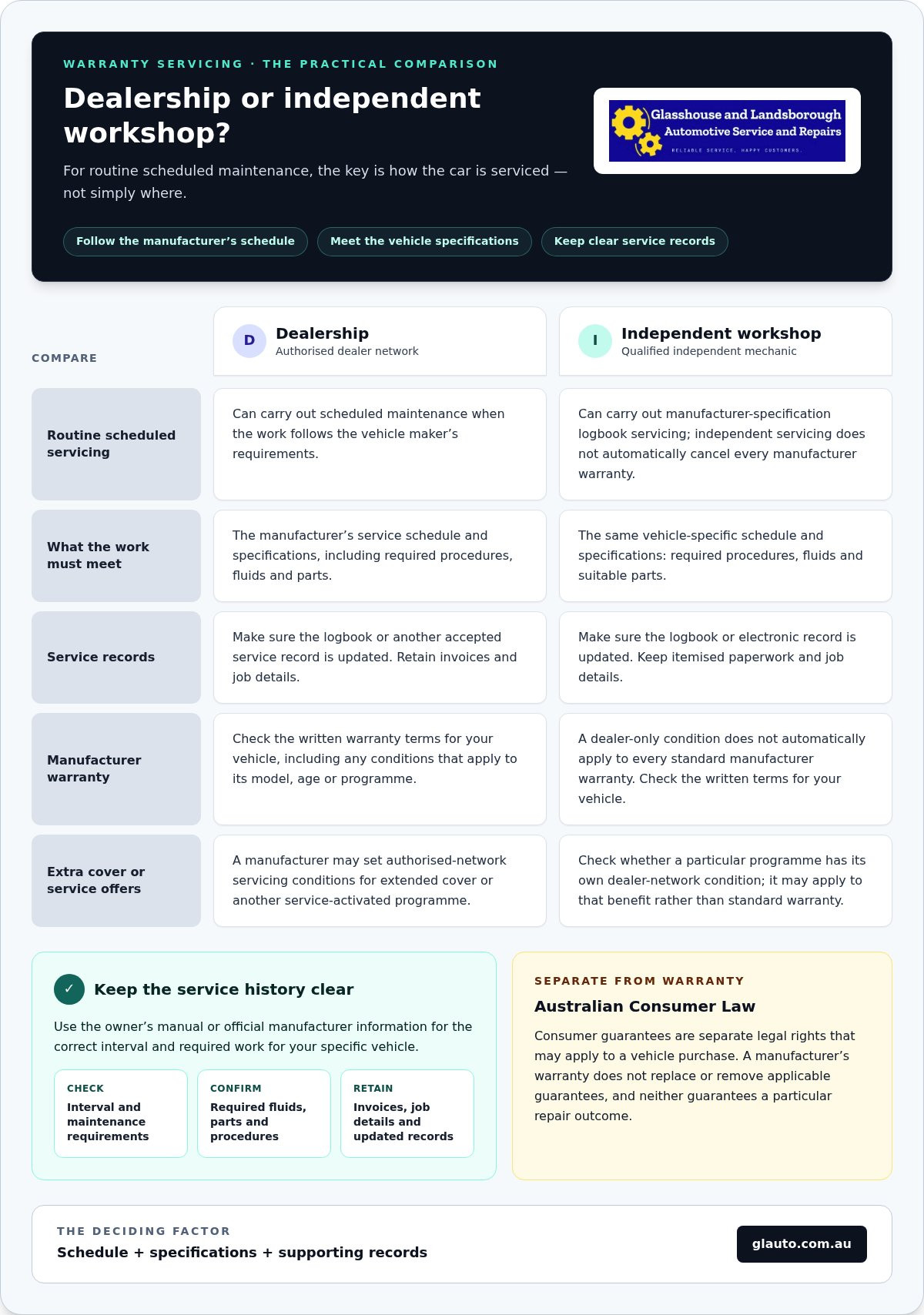
Follow the manufacturer’s servicing schedule and keep clear evidence of each completed service. These are the practical foundations of a car service to maintain warranty, whether you use a dealership or an independent mechanic. The work must meet the vehicle maker’s specifications, including required procedures, fluids and parts, and the service should be recorded in the logbook or another accepted service record.
An independent service does not automatically cancel every manufacturer warranty. The Australian Competition and Consumer Commission has raised concerns about warranty terms that require servicing exclusively through an authorised dealer. The details still matter: warranty terms can differ by vehicle, model, age and programme. Read the conditions for your car rather than relying on another make’s rules.
Does every service have to be done at a dealership?
Not necessarily. For routine scheduled maintenance, the key question is whether the work follows the manufacturer’s schedule and specifications, not simply where it is performed. A qualified independent workshop can carry out manufacturer-specification logbook servicing. As the owner, you should still understand the terms that apply to your vehicle.
Keep routine servicing separate from additional benefits or service-activated offers. A manufacturer may set specific conditions for extended cover or another programme, including a requirement to service within its authorised dealer network. That condition may apply to the additional benefit rather than defining every owner’s standard manufacturer warranty. Read the written terms for each programme, and don’t assume conditions for one brand apply to another.
What does it mean to service a car to maintain warranty?
Scheduled servicing means maintaining the vehicle at the intervals and to the specifications set by its manufacturer. Find the correct time or distance interval in the owner’s manual or official manufacturer information. If the car has a digital service record, check how completed work is documented and retain any paperwork you receive.
Specifications matter because the record should show that required maintenance was completed properly. The correct oil or other fluids, suitable parts and specified procedures help demonstrate that the service matched the schedule. Keep invoices, job details and logbook entries together. If a future claim concerns a particular component, an accurate history makes it easier to establish what work was carried out and when.
- Check the service interval and required work against the car’s own manual or manufacturer information.
- Retain itemised service paperwork and make sure the logbook or electronic record is updated.
A manufacturer’s warranty is a promise governed by its written terms. Australian Consumer Law consumer guarantees are separate legal rights, not a blanket extension of warranty coverage. The Australian Consumer Law (ACL) provides guarantees for eligible vehicle purchases, including cars bought from licensed dealers, and those rights exist alongside a manufacturer’s warranty. Keep the distinction clear: meeting warranty servicing conditions supports a warranty claim, while consumer guarantees are assessed separately under the law.
How warranty conditions, service schedules and consumer guarantees fit together
Three things can be easy to confuse: the manufacturer’s warranty, the vehicle’s service schedule and your rights under Australian Consumer Law. They work alongside one another, but they aren’t interchangeable. The warranty sets out the maker’s promises and conditions for that particular vehicle, while the service schedule explains the maintenance it needs. Consumer guarantees are separate legal rights that may apply to a vehicle purchase.
That distinction matters if a problem arises. A warranty assessment may consider whether required servicing was completed, whether the work followed the stated specifications and whether the records support the vehicle’s maintenance history. A missed interval, unsuitable part or gap in the paperwork could make a claim harder to assess, particularly if the maintenance is relevant to the fault. It does not, by itself, settle every question about warranty coverage or consumer rights.
Manufacturer warranty versus Australian Consumer Law guarantees
A manufacturer warranty is a voluntary promise from the vehicle maker, with coverage and conditions set out in its terms. Australian Consumer Law provides consumer guarantees that apply separately where relevant. As the ACCC explains, a warranty doesn’t replace or remove applicable consumer guarantees. The guarantees are not a blanket promise that every repair will be covered. The outcome depends on the circumstances and the rights that apply.
For example, if a fault appears, the warranty provider may consider the warranty terms and service history. Any consumer guarantee issue is a separate matter, assessed under the law rather than simply decided by the warranty booklet. Don’t assume a warranty claim automatically determines your consumer rights, or that consumer guarantees assure a particular repair, replacement or refund.
Why the vehicle’s service schedule and records matter
Use the owner’s manual or the manufacturer’s official service schedule to find the correct interval and required maintenance for your specific vehicle. Don’t rely on a schedule for a similar model: requirements can differ by vehicle, model year and powertrain. The schedule also shows which work is due, so you can compare the service record with the manufacturer’s requirements later.
Keep the paperwork together, either in a folder or stored digitally. Useful records include:
- Dated invoices showing when the service was carried out.
- Logbook entries or electronic service-history updates.
- Details of parts and fluids used, where recorded.
- Inspection findings and notes about maintenance completed or recommended.
Complete service records create a clear maintenance history, making it easier to show what was done and when. That history can help a warranty assessment distinguish routine maintenance from a fault that needs investigation. For a car service to maintain warranty, match the vehicle’s written requirements with work that can be properly documented.
Glasshouse and Landsborough Automotive provides manufacturer-specification logbook servicing in Landsborough, with preventative checks, fluid changes and vehicle health reports. Keep the report and service record with your vehicle’s maintenance history.
Dealership or independent mechanic: how to compare your servicing options
Choosing where to service your car is a practical decision, not a rule that one workshop type suits every driver. Compare your vehicle’s written requirements with how each option handles scheduled work, records and communication. For a car service to maintain warranty, check that the service will follow the correct schedule and that completed work will be clearly documented.
A dealership may be relevant if your vehicle is covered by a service-activated benefit with network conditions. An independent workshop may suit you if it can carry out scheduled work to the manufacturer’s specifications and provide clear service records. Neither option is automatically right for every car. Your written warranty terms, any additional programme conditions and your priorities all matter.
| What to compare | Dealership | Independent mechanic |
|---|---|---|
| Schedule and specifications | Can carry out scheduled work for the vehicle it services. | Can carry out scheduled work when the service follows the vehicle maker’s specifications. |
| Documentation | Check how completed work is recorded and what paperwork is provided. | Look for clear service entries and records of work completed, parts or fluids used, and findings. |
| Communication | Compare how the service and any findings are explained. | Compare how the service and any findings are explained. |
| Programme conditions | May be relevant where an additional programme specifies an authorised network. | Check whether the programme’s written terms allow independent servicing. |
When a manufacturer-authorised network may be relevant
Some extended or service-activated programmes set conditions for receiving an additional benefit, such as servicing through an authorised network. Read the programme’s official terms before relying on that cover, and distinguish it from the vehicle’s standard manufacturer warranty. Additional programme conditions don’t replace applicable statutory consumer protections under Australian Consumer Law.
What manufacturer-specification independent servicing should cover
For independent servicing, the work should match the schedule and procedures for your specific vehicle, rather than a general estimate based on a similar model. The record should make clear what was completed, with relevant parts or fluids and inspection findings documented where applicable. Keep this account with the logbook or electronic service history.
At Glasshouse and Landsborough Automotive Service and Repairs, scheduled logbook servicing follows manufacturer specifications and includes preventative checks, fluid changes and vehicle health reports. The work and report give you a record of the vehicle’s maintenance and condition at the time of service.
Before deciding, check whether an additional benefit requires network servicing, then weigh schedule compliance, records and communication against what matters to you. Drivers in Landsborough and nearby communities can use manufacturer-specification logbook servicing for scheduled maintenance.
Before your next service: a practical warranty-care checklist
A little preparation makes it easier to book the right work and keep useful records afterwards. Follow these four steps before and after your next scheduled service. They connect your vehicle’s requirements with the paperwork you’ll retain, without treating a complete service history as a guarantee of any particular warranty outcome.
- Check the schedule. Find the next due interval in your owner’s manual or the manufacturer’s official service information. Check both the time and distance guidance, and use the requirements for your specific vehicle rather than relying on a general reminder or information for a similar model.
- Review the warranty terms. Read the written conditions for your vehicle and any separate extended or service-activated programme. Note whether an additional benefit has its own servicing conditions, so you understand what applies before choosing where to book.
- Book and share useful details. Have the service book and previous invoices ready. Tell the workshop about warning lights, unusual sounds, changes in performance or other behaviour you’ve noticed, and when they occur. Clear details help distinguish scheduled maintenance from concerns that may need attention.
- Retain the paperwork. After the service, save the dated invoice, completed service documentation and any updated logbook entry together. Keep a digital copy as well if that suits your record-keeping, and make sure you can find the documents when needed.
What to check before booking a scheduled service
Start with your vehicle’s own maintenance schedule, found in the owner’s manual or official manufacturer information. Confirm the next due date or distance and check whether your warranty programme has separate conditions. Before booking, gather the service book, earlier invoices and a short list of concerns. A note such as “warning light appeared on cold starts” is more useful than a general comment that the car feels different.
What to keep after the service
File the dated invoice and completed service record securely, and check that the paperwork describes the work performed and relevant parts or fluids. If the workshop reports an inspection finding or recommends an additional repair, ask for a clear explanation of what it relates to and whether it is separate from the scheduled service. Keep that information with your records, even if you decide to address it later.
For a car service to maintain warranty, accurate preparation and tidy records make your maintenance history easier to follow. Glasshouse and Landsborough Automotive provides logbook servicing to manufacturer specifications, with preventative checks, fluid changes and vehicle health reports. Book logbook servicing in Landsborough and keep the next step in your vehicle’s maintenance history on track.
Maintain your warranty with local logbook servicing in Landsborough
Drivers in Landsborough, Glass House Mountains, Beerwah and nearby hinterland communities can have scheduled logbook servicing carried out at Glasshouse and Landsborough Automotive Service and Repairs, a locally owned independent workshop in Landsborough. The workshop has operated since 2013, providing a local option for owners who want their vehicle serviced to manufacturer specifications and its maintenance recorded clearly. The team also serves drivers from Beerburrum, Peachester, Mount Mellum, Mooloolah Valley, Glenview, Bald Knob and Maleny.
A well-documented service history can help show what maintenance has been completed, but no workshop can promise a particular warranty outcome. Follow the service schedule and understand the conditions in your vehicle’s warranty terms. Service records and vehicle health reports give you useful information to retain with your car’s history.
What local logbook servicing at the workshop involves
Scheduled logbook servicing is carried out in accordance with the vehicle manufacturer’s specifications. The service includes preventative checks and fluid changes, with the work guided by the requirements for your vehicle rather than a one-size-fits-all checklist. A vehicle health report gives you a written view of its condition at the time of service.
Keep that information alongside your invoice and logbook entry, then refer to it when planning future maintenance. Following the correct schedule remains the owner’s responsibility, so use the service interval for your specific vehicle and keep its records together. This is a practical part of arranging a car service to maintain warranty, without treating paperwork as a guarantee that a claim will be accepted.
Book your next service with the Landsborough team
Before booking, bring your service book or available digital history, along with previous invoices if you have them. Let the team know the next service interval shown in your vehicle information and mention any warning lights, unusual sounds or changes in how the car behaves. Sharing this context helps the workshop understand the vehicle’s maintenance background and what you’d like addressed during the visit.
After servicing, keep the invoice and vehicle health report with the rest of your records. If the report notes recommended work beyond scheduled maintenance, review the explanation so you have a clearer picture of the vehicle’s condition and possible next steps.
Glasshouse and Landsborough Automotive welcomes drivers from Landsborough and nearby communities for manufacturer-specification logbook servicing. Bring your vehicle’s service history and discuss the upcoming interval with the team. Book a logbook service.
Make your next service part of a clear maintenance routine
Use your next service as a fresh point to organise the records and reminders that help you stay on top of future maintenance. Keep the owner’s manual, warranty documents and service paperwork somewhere easy to find, and note the next due interval after each visit. A steady routine makes it easier to plan ahead and gives you a clearer picture of your car’s care over time.
Choosing a car service to maintain warranty starts with your vehicle’s own requirements. Then arrange a service that suits your needs and bring the service history, including any questions about the car’s condition or upcoming maintenance.
For drivers in Landsborough and nearby Sunshine Coast hinterland communities, Glasshouse and Landsborough Automotive offers a local place to keep that routine moving. Book your logbook service with the Landsborough team and take the next step in caring for your vehicle.
Frequently Asked Questions
Can I get my car serviced by an independent mechanic and keep the warranty?
Yes, using an independent mechanic doesn’t automatically cancel every manufacturer warranty. For a car service to maintain warranty, follow the schedule and requirements for your specific vehicle, and check whether any additional service-activated cover requires an authorised network. Keep invoices and service entries that show when work was done and what it involved. If a fault arises, the warranty provider assesses the claim against its terms and circumstances, so no particular outcome is guaranteed.
Does servicing my car outside the dealership void the warranty?
No. Having routine work done outside the dealership isn’t, by itself, enough to void every manufacturer warranty. The work still needs to meet the applicable schedule and requirements, and a separate brand programme may set its own conditions. A claim is assessed against the written terms and the circumstances of the fault. Australian Consumer Law guarantees are separate protections; consult current ACCC guidance to understand how they may apply to your situation.
What happens if I miss a scheduled car service?
The effect depends on your vehicle’s warranty terms, how late the service is, what maintenance was due and whether the delay relates to a later fault. Arrange the overdue service and explain the gap in the history rather than assuming the warranty has automatically ended. Keep the new service documentation and any notes about the delay. A later service doesn’t automatically restore cover, and the specific circumstances inform an assessment.
Do I have to use genuine parts to maintain my car warranty?
Not in every case as a universal rule. Check the manufacturer’s specifications and warranty terms for the scheduled work, including the required standard for parts and fluids. The important point is that the work follows the vehicle’s requirements. A genuine-branded part alone doesn’t establish that every service condition has been met. Keep an invoice that identifies the work and relevant parts used, so there’s a clear record if questions arise later.
What records should I keep after a car service?
Keep the dated invoice, the service-book entry or digital update, and any paperwork describing the work completed. Retain relevant details about parts or fluids, along with inspection findings or notes about recommended work. Store these together with the owner’s manual or service schedule, either in a dedicated folder or a secure digital file. Clear records help explain the car’s maintenance history, but they don’t automatically prove that every warranty condition has been met.
Are Australian Consumer Law guarantees the same as a car warranty?
No. A manufacturer warranty is a voluntary promise with its own written terms, while Australian Consumer Law consumer guarantees are separate statutory protections that may apply to a vehicle purchase. A warranty can’t remove applicable consumer guarantees, but those guarantees aren’t blanket cover for every fault or repair. The circumstances matter. Check current ACCC guidance for details, and don’t assume this general explanation determines whether a particular claim is covered.
How do I find the correct service interval for my car?
Use the owner’s manual, official service schedule or manufacturer information for your specific vehicle. Intervals and requirements can differ by make, model, year and usage, so a generic kilometre figure may not fit your car. If you’re booking from Landsborough, Glass House Mountains, Beerwah, Beerburrum, Peachester, Mount Mellum, Mooloolah Valley, Glenview, Bald Knob or Maleny, bring the service history so the workshop can see what maintenance has already been recorded.

